



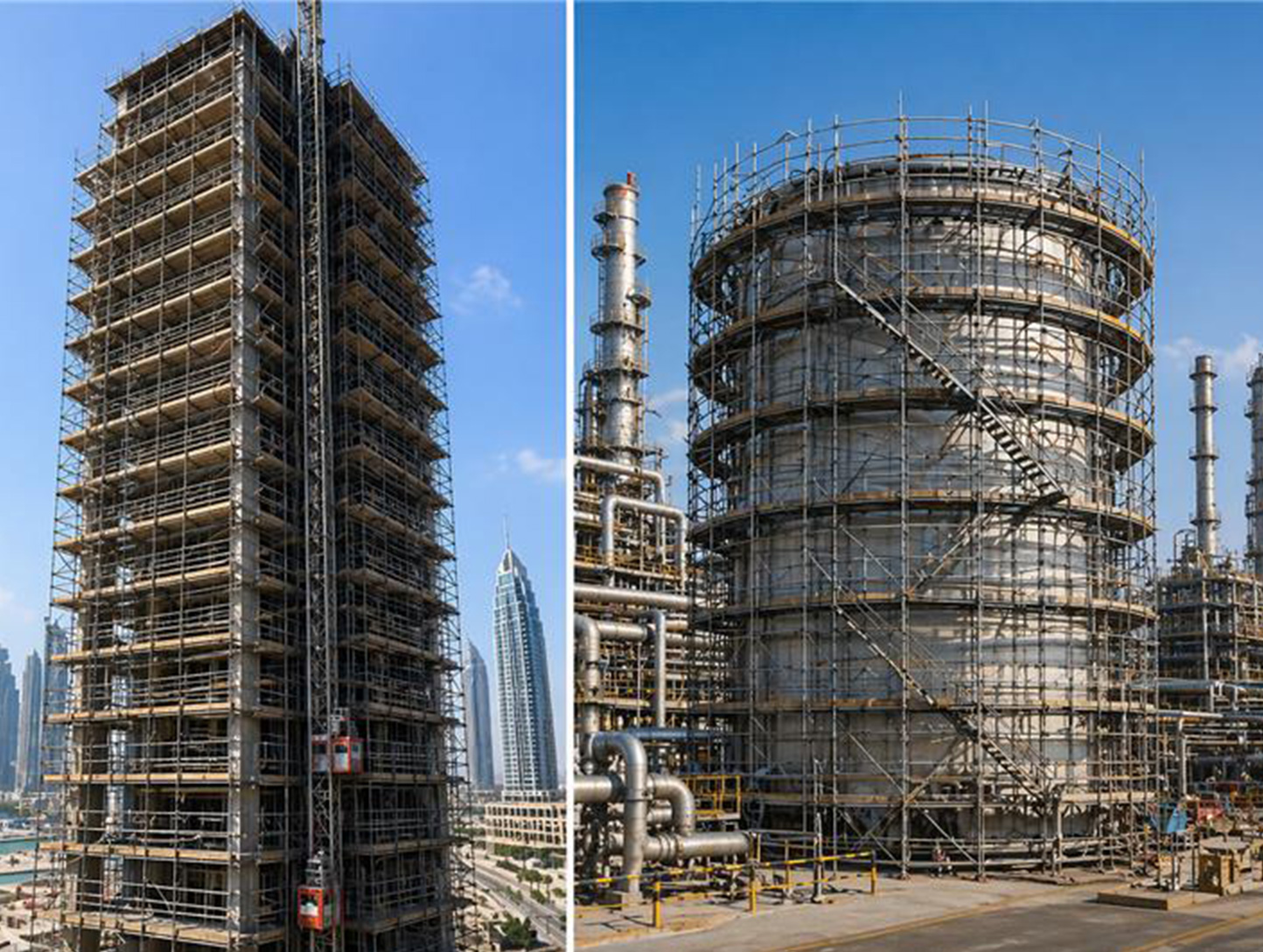
-
Table of Contents:
1. How Cuplock and Ringlock Scaffolding Distribute Load Differently
2. Where to Use Cuplock vs Ringlock: UAE Project Applications
3. Cuplock vs Ringlock: Side-by-Side Comparison Table
4. UAE Compliance Factors That Should Drive Your Specification
5. 4 Scaffolding Specification Mistakes UAE Contractors Make
6. Why the "Cuplock Is Always Cheaper" Assumption Is Costing Projects Money
Cuplock vs Ringlock Scaffolding UAE: Which System Should You Specify
Cuplock scaffolding is faster to erect and dismantles efficiently in repetitive vertical structures, making it ideal for high-rise residential and infrastructure projects across the UAE. Ringlock offers superior load-bearing flexibility and multi-directional connections, making it the preferred choice for complex industrial, curved, or irregular-geometry builds. The right system depends on project geometry, load requirements, and site logistics.
Across UAE construction sites, Cuplock gets specified by default more often than it gets specified by decision. It is familiar, widely available, and the crews know it. That familiarity is a real advantage on the right project. On the wrong one, it becomes the most expensive assumption on the programme.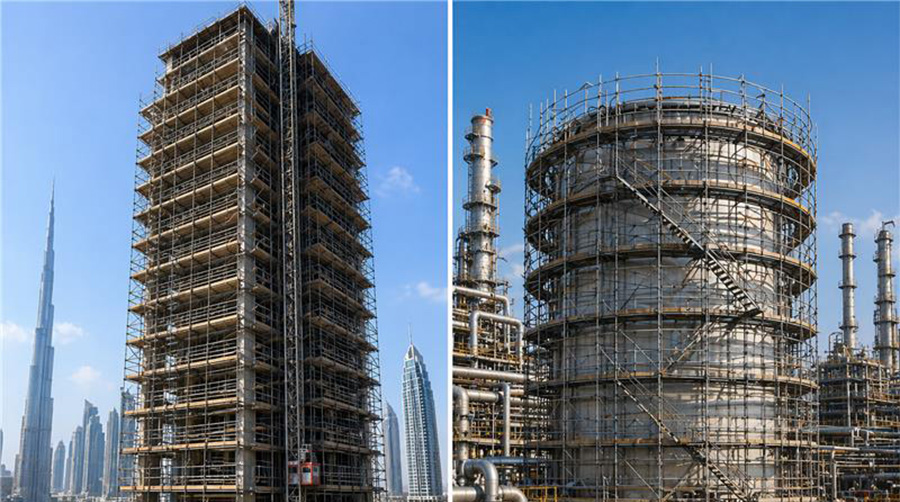
This is where the Cuplock vs Ringlock scaffolding UAE decision becomes critical. The UAE builds at a scale and pace that leaves little room for mid-project corrections. From high-density residential towers in Dubai to ADNOC facility turnarounds in the Western Region, each project type places different demands on the scaffolding system. Specifying without accounting for those demands does not just create a technical problem. It creates a procurement problem, a schedule problem, and sometimes a regulatory one.
Quad Dream supports projects across this full spectrum, and the system selection conversation happens early on almost every job. What follows is a practical breakdown of how each system behaves, where each one performs in UAE conditions, and what the specification decision should be based on.
How Cuplock and Ringlock Scaffolding Distribute Load Differently
The structural logic of each system is what should drive specification, not availability or habit.
Cuplock
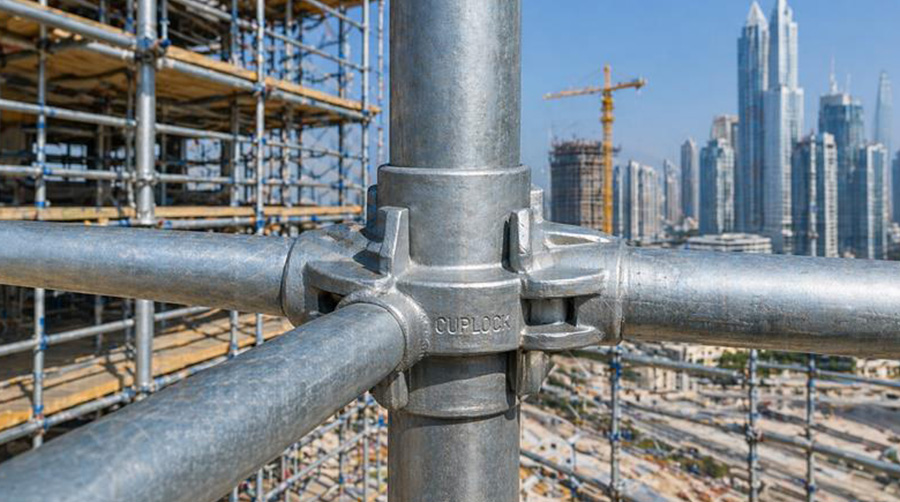
The top cup on a Cuplock standard locks up to four horizontal ledgers simultaneously in a single motion. It is fast, intuitive for erection crews, and mechanically clean on uniform structures. The constraint is that every connection is fixed at 90 degrees. If the project geometry holds that angle throughout, Cuplock rewards you with speed and simplicity. If it does not, every deviation requires additional tube-and-coupler fittings, which adds components, extends inspection scope, and slows the erection rate that made Cuplock attractive in the first place.
On a standard residential tower with consistent floor-to-floor heights and uniform bay widths, Cuplock typically carries between 40 and 60 kN per standard with correct base plate specification and adequate ground bearing. It is a system that rewards repetition.
Ringlock

The rosette disc at the heart of every Ringlock node accepts up to eight ledger connections at variable angles, and none of them require additional fittings. That one design characteristic is what separates it from Cuplock in practical terms. Multi-directional bracing is not an add-on. It is inherent to the system.
This makes Ringlock the more adaptable system on irregular structures, curved facades, and anything that does not hold a consistent orthogonal grid. The rosette spacing supports staircase towers, circumferential platforms, and complex access configurations within the same component family. Ringlock standards typically carry between 60 and 80 kN, depending on configuration, loading conditions, and base support. There is also a documentation advantage: each component carries a unique rosette code, which creates a traceable audit trail that simplifies third-party inspection on government and regulated contracts.
Worth noting for UAE sites: Steel joint tolerances are affected by thermal expansion at Gulf ambient temperatures, which regularly exceed 50°C. This applies to both systems and needs to be addressed in the scaffold design. On Ringlock, the tighter manufacturing tolerances in the rosette connections mean this must be explicitly specified, not assumed, when working in extreme heat conditions.
Where to Use Cuplock vs Ringlock: UAE Project Applications
Where Cuplock Makes Sense
Residential towers on developments like Dubai Silicon Oasis or Reem Island Abu Dhabi are natural fits. Standard floor plates, regular setbacks, and the need to move fast across many floors are exactly the conditions Cuplock was designed for.
Bridge falsework on road infrastructure across Dubai and Abu Dhabi follows the same logic. Where span geometry is predictable and the primary specification requirement is uniform load distribution, there is no structural reason to use a more complex system.
Mid-rise maintenance work on commercial buildings, retail podiums, and rectangular hotel facades also suits Cuplock well, particularly where labour cost and erection speed weigh more heavily than geometric flexibility. The same applies to shoring and temporary works in basement construction, where maintaining a consistent vertical grid throughout the works is straightforward.
Where Ringlock Is the Better Choice
Curved facade access on airport terminal expansions, DXB and AUH being relevant examples, requires bay geometry that Cuplock cannot accommodate within its own system. The same is true for luxury hotel facades with non-standard setbacks and stadium tiers where consistent 90-degree connections are structurally inefficient.
Petrochemical and industrial work presents a different but equally strong case. At KIZAD, Ruwais, and ADNOC maintenance facilities, the vessel and pipe geometry makes multi-directional access a functional necessity, not a preference. Ringlock's rosette node handles this natively.
For industrial storage tanks, particularly floating roof tanks and large-diameter vessels, the circumferential scaffold needs to follow the curve of the structure continuously, and Ringlock accommodates that within a single component family.
Civic and stadium builds with irregular geometry round out the picture. Where Cuplock would require a significant number of additional couplers to achieve the same configuration, Ringlock often becomes the more cost-effective system on a total components basis, not just the more technically appropriate one.
A Note on Hybrid Deployment
On certain large or phased projects, Tier-1 contractors are now using Cuplock for the primary vertical access towers and Ringlock in zones where the geometry becomes complex. Quad Dream's contracting teams have used this approach on mixed-use developments in Dubai, where it has reduced overall scaffolding rental cost while maintaining structural integrity at the points where it matters most. The requirement is that both systems are independently designed and third-party inspected. Mixing them within the same scaffold structure is not permitted and is addressed further under specification mistakes below.
Factor Cuplock Ringlock Recommended Erection speed (repetitive geometry) Fast Moderate Cuplock Geometry flexibility Limited (90° fixed) High (8-way rosette) Ringlock Skilled labour required Lower Higher Cuplock Local hire availability Wide Specialist only Cuplock Complex or curved structures Inefficient Optimised Ringlock Reconfiguration speed Moderate Fast Ringlock Load documentation and audit trail Standard Enhanced Ringlock Wind bracing on coastal projects Additional fittings needed Built-in multi-directional Ringlock Verdict: Cuplock wins on speed, availability, and labour cost for standard geometry. Ringlock wins on flexibility, bracing efficiency, and audit-trail quality for complex or regulated projects. For low-level and finishing-stage access, an aluminium mobile scaffold tower should be considered before either system is specified. Neither system is universally superior.
UAE Compliance Factors That Should Drive Your Specification
Compliance in the UAE does not favour one system over the other. What it does require is that the design, erection process, and inspection methodology are all fit for purpose regardless of which system you choose.
OSHAD SF Technical Guideline 01-3 covers both Cuplock and Ringlock without distinction. A Ringlock structure erected without a proper design is not compliant. A Cuplock structure with a sound design and competent inspection is. The system does not determine compliance. The process does.
Wind loading is where the two systems create a practical difference, particularly under Abu Dhabi CP-2 zone requirements. Coastal and offshore-adjacent projects must include scaffold-specific wind bracing calculations. Because Ringlock's multi-directional rosette bracing is built into the system, it simplifies CP-2 compliance on tall structures without additional components. Achieving the same result on Cuplock requires supplementary tube-and-coupler fittings, which add both material cost and inspection scope.
ADNOC and DEWA contracts typically mandate independent structural assessments as a condition of the works. Scaffold design calculations with stamped engineering drawings are expected from the outset. If your scaffolding contractor cannot provide these, that is a procurement risk, not just a technical one.
Dubai Municipality DM-B18 requires scaffold permits backed by signed design calculations above defined height thresholds, and this applies to both systems equally.
On Estidama Pearl-rated projects and LEED-registered developments, Ringlock's component-level traceability through unique rosette codes is increasingly referenced in materials documentation credits. Cuplock does not currently offer equivalent traceability at the component level. As documentation and sustainability requirements become more standard across UAE government tenders, this difference is worth factoring into your long-term specification approach.
4 Scaffolding Specification Mistakes UAE Contractors Make
1. Selecting Cuplock for Projects with Irregular Geometry
This is the most common and most expensive specification error in the UAE market. When a project with curved facades, non-orthogonal setbacks, or irregular floor geometry gets specified as Cuplock at tender stage and the problem surfaces during erection, the correction typically adds 15 to 20 percent to the scaffold package value. Programme delays of two to three weeks are standard. The fix is not a design change. It is a procurement restart.
A geometry review at pre-construction stage takes far less time and costs nothing compared to what a mid-project conversion costs. Any non-orthogonal facade, curved element, or irregular setback should be flagged before a system is selected.
2. Not Accounting for Ringlock Lead Times
Ringlock is not a system you can procure on short notice in the UAE. Distributors carry limited stock, and on larger packages, delays of six to eight weeks are not uncommon. This is not an exception. It is a consistent characteristic of the local supply chain.
Procurement for any significant Ringlock package needs to begin eight to twelve weeks ahead of mobilisation. If the programme cannot accommodate that window, it is worth reassessing whether Cuplock with additional engineering input is the more practical route, even on a project where Ringlock would otherwise be the stronger technical choice.
3. Treating the Two Systems as Interchangeable
Cuplock and Ringlock components cannot be mixed, either between the two systems or across different manufacturers within the same system family. Mixing components voids the structural warranty of the scaffold and will result in inspection failures on regulated sites. On ADNOC and DEWA projects, this can stop the works entirely.
Single-source procurement per system per project is the standard practice. Component compatibility should be confirmed with your scaffold designer before any purchase order is raised.
4. Proceeding Without a Scaffold Design
The belief that a straightforward structure does not require a formal design is one that has not held up in UAE enforcement proceedings. Labour courts and OSHAD enforcement actions have found against contractors following scaffold incidents where no documented design existed, and the choice of system has not been a mitigating factor. Cuplock does not exempt a structure from the requirement.
A scaffold design is required for any structure above 4 metres or supporting process loads. This is not a conditional requirement. It applies regardless of project type, system choice, or how the structure looks on paper.
Why the "Cuplock Is Always Cheaper" Assumption Is Costing Projects Money
The logic behind the Cuplock default is not wrong. It is faster to erect, more widely available, requires less specialised labour, and carries a lower hire rate. On a standard project with predictable geometry and a straightforward programme, it is often the right choice.
The problem is that this logic gets applied without checking whether the project conditions actually match those assumptions. On phased developments, industrial turnarounds, and projects where the scope changes across programme stages, reconfiguration becomes a significant cost driver. When a structure needs to be reconfigured more than twice, Ringlock's faster adaptation typically reduces total erection hours enough to offset the higher hire rate within six to eight weeks. This is a calculation that can be modelled before tender, and Quad Dream's estimating team does it regularly for clients on industrial and phased projects where the numbers move in Ringlock's favour.
There is also a shift in the regulatory environment that is worth watching. Government tenders and Estidama-rated projects are moving toward stronger requirements around documentation, material traceability, and third-party verification. Ringlock's component-level traceability is better positioned for where those requirements are heading than Cuplock currently is.
Expert Position: The cheapest scaffold system is the one specified correctly the first time, not the one with the lowest day rate. A Ringlock specification that prevents one mid-project conversion will consistently outperform a Cuplock default that did not account for the project geometry.
Frequently Asked Questions
1. What is the main difference between Cuplock and Ringlock scaffolding?
Cuplock uses a top-cup-and-blade locking mechanism that connects horizontals at fixed 90-degree nodes. It is a fast and efficient system on repetitive structures. Ringlock uses a rosette disc that accepts up to eight connections at variable angles, making it the more capable system for complex geometry and multi-directional bracing without requiring additional fittings.
2. Which system is better for UAE high-rise construction?
For towers with standard rectangular floor plates, Cuplock is generally the stronger choice based on erection speed and local availability. Where the tower includes curved facades, irregular setbacks, or complex cantilevered platforms, Ringlock provides structural and logistical advantages that justify the higher hire cost over the life of the project.
3. Is Ringlock scaffolding compliant with UAE safety regulations?
Yes. Both systems are compliant with OSHAD guidelines when the scaffold is properly designed, erected by competent persons, and inspected to the required standard. Compliance is a function of the design and inspection process, not of the system itself.
4. Can Cuplock and Ringlock be used together on the same project?
They cannot be mixed within a single scaffold structure, as the two systems are structurally incompatible. However, they can be deployed in separate zones on the same project, provided each zone is independently designed and inspected.
5. Which system is more cost-effective for petrochemical projects?
Ringlock is the standard choice for petrochemical and industrial turnarounds at facilities like KIZAD and Ruwais. The vessel and pipe geometry at these sites requires multi-directional access that Ringlock handles natively. Although the day rate is higher, reduced reconfiguration time means total scaffold hours are typically lower, making Ringlock the more cost-effective option across the full project lifecycle.
Neither Cuplock nor Ringlock is a universal answer. They solve different problems, and the UAE construction market is varied enough that both systems are the right choice depending on what is being built and how.
What drives the decision is project geometry, how often the structure will need to be reconfigured, what the regulatory and documentation requirements are, and what the local supply chain can realistically deliver within your programme. The system your team has always used is not one of those criteria.
Settling the specification at pre-construction, backing it with a scaffold design, and holding a single-source procurement position are the practical steps that separate a well-managed scaffold package from one that becomes a programme issue halfway through the works.
Quad Dream's engineering team supports clients through this process from pre-construction to third-party inspection, on both Cuplock and Ringlock projects. Get in touch to talk through your project requirements.


