



Table of Contents
1. What Scaffolding System Is Best for High-Rise Construction in Dubai?
2. The Scaffolding System Decision That Gets Made Too Late on Dubai High-Rise Projects
3. Scaffolding System Comparison for Dubai High-Rise Projects
4. Why Cuplock Scaffolding Is the Preferred Choice for External High-Rise Work in Dubai
5. When Frame Scaffolding or Mobile Towers Are the Right Choice and When They Are Not
6. What Dubai Municipality and OSHAD Require for High-Rise Scaffolding
7. The Cost Factor Most Project Managers Underestimate
8. One System Cannot Serve an Entire High-Rise Project
10. Specify the System, Not Just the Structure
What Scaffolding System Is Best for High-Rise Construction in Dubai?
For high-rise construction in Dubai, cuplock scaffolding is the standard system for external facades and multi-level access, selected for its load-bearing performance, erection speed, and ability to accommodate complex building geometries. Frame scaffolding works well during fit-out phases on lower floors. The right system for any project is determined by structural load, facade configuration, wind exposure, and how access requirements evolve across the build programme.
The Scaffolding System Decision That Gets Made Too Late on Dubai High-Rise Projects
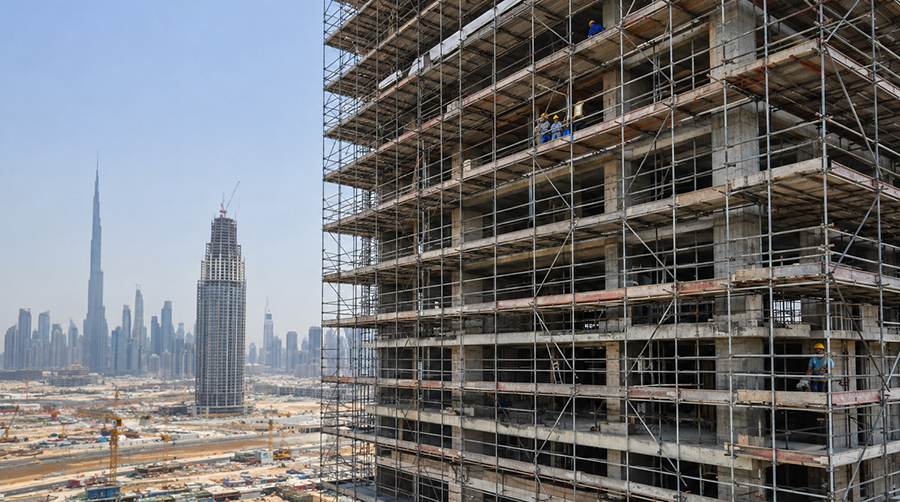
There is a recurring pattern on Dubai high-rise projects where scaffolding system selection gets treated as a procurement formality rather than an engineering decision. The system gets chosen close to mobilisation, often based on availability and price, and the structural implications only surface once the project is underway.
At upper floors, that shortcut becomes expensive. A system that performed adequately at ground level may lack the load capacity the superstructure phase demands. A facade with setbacks, cantilevered slabs, or curtain wall geometry may make the originally specified bay configuration unworkable. By that point, re-procurement is not just a cost issue. It is a schedule issue that affects every trade working above the scaffolding line.
The position that any certified scaffolding system is adequate for high-rise work misreads how these projects actually function. External access, wind exposure, DM permit conditions, and the load demands of concurrent trades all vary floor by floor. A system that is not selected against those variables from the outset will create problems at the point where they are hardest to fix
Scaffolding System Comparison for Dubai High-Rise Projects
A Dubai high-rise build moves through three broad phases: substructure and basement, superstructure construction, and facade completion with internal fit-out. Each phase has a different access profile, load requirement, and compliance obligation. Understanding which system fits which phase is more useful than asking which single system is best.
The comparison below maps the four systems most deployed on Dubai high-rise projects against the criteria that influence specification. Read it alongside your project's structural drawings and facade schedule, not as a standalone procurement guide.
| Criteria | Cuplock Scaffolding | Frame Scaffolding | Aluminium Mobile Tower | Suspended (Gondola) System |
|---|---|---|---|---|
| Typical max height | No structural limit (engineered) | Up to 50m (project-specific) | Up to 12m working height | Full building facade |
| Primary use in Dubai high-rise | Superstructure, external facade | Lower floors, fit-out access | Interior MEP, finishing | Post-construction facade maintenance |
| Load capacity | High, up to 675 kg/m² | Medium, varies by frame | Class 2 to 3 (150 to 225 kg) | Rated per gondola system |
| Speed of erection | Fast (cup-and-spigot connection) | Moderate | Very fast | Installation-intensive |
| Dubai Municipality compliance | Standard on DM-regulated sites | Accepted with inspection | BS EN 1004 certified units | Requires separate DM approval |
| Wind load suitability | High, suitable for UAE exposure | Moderate, requires engineering above 30m | Low, outriggers required outdoors | Engineered per project |
| Typical project type in Dubai | High-rise residential, commercial towers | Fit-out, lower-rise commercial | Interior fit-out, MEP works | Building facade works, hotels |
Why Cuplock Scaffolding Is the Preferred Choice for External High-Rise Work in Dubai
The buildings going up across Dubai are rarely simple rectangular extrusions. Floor plates step in and out. Balconies cantilever beyond the structural slab. Curtain wall systems run at angles that make a standard bay grid unworkable. Cuplock handles these conditions because its adjustable bay widths and cup-and-spigot connections give erection crews the ability to configure non-standard bays that follow the actual building geometry rather than working against it. Frame scaffolding cannot offer the same flexibility without a significant volume of supplementary fittings that add weight, cost, and inspection complexity.
Wind loading is the other driver. Dubai's coastal towers and sites adjacent to open desert face sustained wind pressure at height that requires the scaffold to be tied back to the primary structure at regular intervals. Cuplock's tie-back configuration is well established on DM-regulated high-rise projects and is the practical standard for managing that exposure at 20, 30, and 40 floors.
Quad Dream's scaffolding rental and contracting services in Dubai are built around these conditions, with scaffold designs produced for each project rather than standard configurations applied across different building types.
When Frame Scaffolding or Mobile Towers Are the Right Choice and When They Are Not
Fit-Out Contractor on Floors 1 to 5 of a Commercial Tower in JLT
At this scale, frame scaffolding or aluminium mobile towers are the practical choice. Working heights are manageable, the floor plates are typically standard, and the programme does not justify a full contracting package. Mobile tower rental for MEP and ceiling access is cost-effective and quick to mobilise at this level.
Main Contractor on a 40-Floor Residential Tower in Dubai Marina
This is a cuplock contracting scope. The combination of building height, waterfront wind exposure, complex balcony geometry, and DM inspection requirements means the scaffold needs to be engineered, tied to the structure, and managed throughout by an experienced scaffolding contractor. Rental without a contracting arrangement is not the appropriate procurement route here.
Post-Construction Facade Works on a Downtown Dubai Hotel
Full external scaffolding is rarely the most efficient solution at this stage. Suspended access systems, mast climbers, or a combination with mobile aluminium towers will typically be more practical and less disruptive. This is a distinct procurement decision from the original build scaffolding and usually involves specialist access input rather than a direct continuation of the main scaffolding contract.
Project Phase to Scaffolding System Mapping
| Project Phase | Recommended System | Supplier Role | Quad Dream Service |
|---|---|---|---|
| Substructure and basement | Frame scaffolding or cuplock | Rental or contracting | Scaffolding Contracting |
| Superstructure (floors 1 to 40+) | Cuplock (external) | Contracting with engineering | Scaffolding Contracting |
| Interior MEP and finishes | Aluminium mobile towers | Rental | Aluminium Mobile Tower Rental |
| Facade cladding and curtain wall | Cuplock (tied) | Contracting | Scaffolding Contracting |
| Snagging and touch-up works | Mobile towers or hop-up | Short-term rental | Scaffolding Rental |
What Dubai Municipality and OSHAD Require for High-Rise Scaffolding
Compliance on a Dubai high-rise scaffolding package is not a single checkbox. It is a set of obligations that apply at different heights, different project stages, and under different authorities.
Design Approval and Site Operations
On structures above a defined height, Dubai Municipality requires scaffold designs to be produced and stamped by a qualified structural engineer before erection begins. These are not submitted after the fact. DM inspectors verify design compliance during site visits, and structures erected without the required calculations are vulnerable to stop-work notices regardless of how the scaffold looks physically.
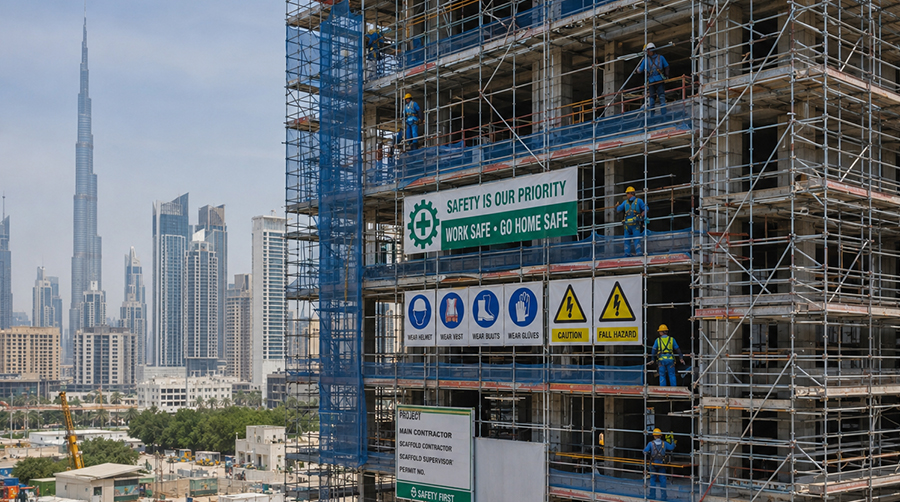
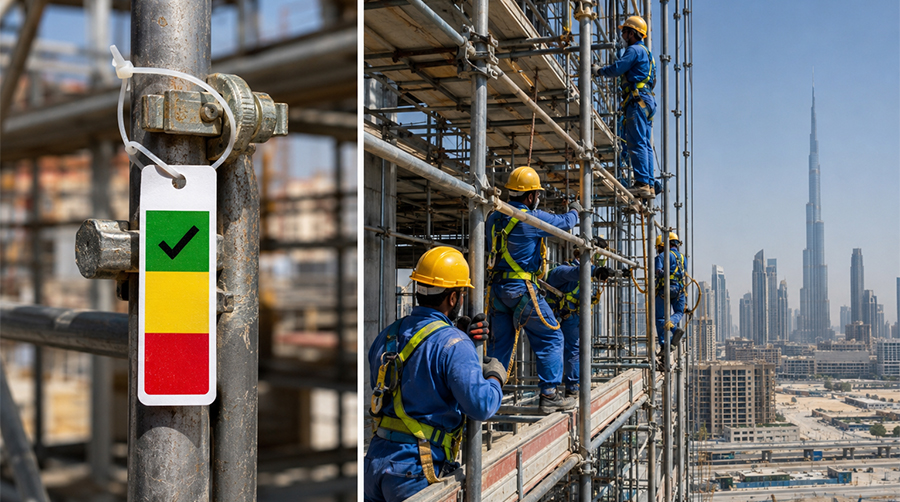
OSHAD SF requirements govern day-to-day operations. Supervisors must be documented as competent persons, the scaffold register must be maintained throughout the project, and the inspection tag system must be kept current. A red tag on a scaffold leg stops work at that level. That is not a discretionary enforcement; it is how the system is designed to function.
Tie-Back Requirements and Contractor Liability
Tie-back requirements to the primary structure become mandatory at height. DM specifies tie frequency at defined vertical and horizontal intervals, and compliance is verified as part of the ongoing inspection process during superstructure works.
How scaffolding is procured also determines who carries the compliance liability. Under a full contracting scope, the scaffolding contractor takes responsibility for design, erection, and inspection throughout. Under a rental arrangement, that responsibility sits with the client's site team. On Dubai high-rise projects, most main contractors opt for a contracting scope specifically to avoid that exposure. Quad Dream's QHSE standards and scaffolding contracting service are structured to hold that responsibility from design through to dismantling.
The Cost Factor Most Project Managers Underestimate
Erection time and crew requirements do not scale proportionally with height. Above 30 floors, crane usage for material lifts, daily inspection cycles, and crew size all generate costs that never appear in the day rate comparison.
A two-day scaffolding delay at floor 25 rarely stays contained to the scaffolding package. Crane standby charges on a Dubai high-rise typically run between AED 8,000 and AED 15,000 per day depending on crane type and contract terms. A structural or MEP crew idled for the same period on a 20-person team adds another AED 10,000 to AED 20,000 in unproductive labour. If the delay pushes into a programme critical path, the cost of a one-day extension across concurrent trade packages can exceed the entire monthly scaffolding hire cost. None of those figures show up when two scaffolding quotes are compared on day rate alone.
System selection at pre-tender stage reduces this exposure in specific, measurable ways. Bay configurations locked in before award mean erection crews arrive with a validated layout rather than solving geometric problems on site. DM scaffold designs submitted and approved ahead of mobilisation remove the permit delay that commonly adds one to two weeks to programme start. And mobilisation lead times, particularly for cuplock on large high-rise packages, built into the programme from the outset mean material is on site when the structure is ready, not two weeks after. That level of preparation does not happen through last-minute rental. It requires a contracting relationship established at the planning stage.
One System Cannot Serve an Entire High-Rise Project
Specifying a single scaffolding system for the full build simplifies procurement but consistently underdelivers in practice. Dubai high-rise projects need a layered approach: cuplock externally for the superstructure, mobile towers internally for MEP and fit-out, and suspended or specialist access for post-construction facade works. Using cuplock for interior fit-out is over-specified. Using mobile towers for external work above five floors is non-compliant. Projects that manage both programme and compliance effectively are those where the scaffolding contractor is involved at pre-tender stage, before access decisions get locked into the procurement schedule.
Frequently Asked Questions
What scaffolding system is used for high-rise construction in Dubai?
Cuplock scaffolding is the standard for external high-rise work in Dubai, chosen for its load capacity, tie-back compatibility, and suitability for UAE wind conditions. It is the primary system Quad Dream deploys on high-rise projects across Dubai and the UAE.
Does Dubai Municipality require scaffolding design approval for high-rise buildings?
Yes. Scaffolding above a defined height threshold must be designed by a structural engineer before erection begins. DM inspection teams verify compliance throughout the works, and structures without stamped calculations are subject to enforcement action.
What is the load capacity of cuplock scaffolding?
Cuplock scaffolding carries up to 675 kg/m² in standard configuration. Actual capacity depends on bay size and system configuration. Quad Dream engineers all cuplock packages to project-specific load requirements rather than catalogue assumptions.
Can aluminium mobile scaffold towers be used on high-rise construction sites in Dubai?
Yes, for interior work within the 12-metre working height limit. They suit MEP installation, fit-out, and finishing works within floor plates. External work on high-rise structures requires a fixed, tied scaffolding system.
How does wind affect scaffolding system selection for tall buildings in Dubai?
External scaffolding above approximately 10 metres on open sites requires wind load calculations. Tied cuplock with back-ties to the structure is the standard for Dubai high-rise work. Coastal and desert-adjacent sites face additional shamal wind exposure that must be factored into the design from the outset.
Specify the System, Not Just the Structure
The choice of scaffolding system for a Dubai high-rise project is not a catalogue decision. Each phase of the build places different demands on the access structure - cuplock externally for the superstructure, mobile towers internally for MEP and fit-out, and suspended or specialist access for post-construction facade works. Meeting those demands requires different systems, different engineering inputs, and different supplier capabilities working in sequence.
Contractors who bring a scaffolding contractor into the planning process at tender stage rather than procurement stage consistently see better programme outcomes and fewer compliance interruptions.
If your project team is in the planning stage or pre-tender stage, Quad Dream can provide a site-specific scaffolding assessment before system selection is finalised.


