




Table of Contents
- What Are Scaffold Nets and Tarpaulins?
- Scaffold Nets vs Tarpaulins: Key Differences
- Why Dubai High-Rise Projects Need Both
- Benefits of Scaffold Netting in Construction
- Construction Site Weather Protection: How Tarpaulins and Nets Work Together
- Safety, Fire Rating and Compliance on Dubai High-Rise Sites
- How to Choose the Right Scaffold Nets and Tarpaulins
- Frequently Asked Questions
- Planning Safer, Better-Protected High-Rise Sites
Scaffold nets and tarpaulins for high-rise construction serve different but complementary purposes. Scaffold nets, usually made from knitted HDPE or PE mesh, help contain loose debris and reduce dust while allowing airflow. Construction tarpaulins are solid PE, PVC or laminated sheets that provide greater protection against rain, dust and exposure during finishing work. In Dubai, where high-rise projects face strong winds, summer heat, airborne dust and busy surroundings, choosing the right combination helps manage site risks without overlooking scaffold stability.
Both materials need to be selected according to the work, site conditions, and temporary works design. Neither should be treated as a substitute for engineered fall protection or other required safety measures.
Key Takeaways
- Scaffold nets help contain loose debris and reduce dust while allowing air to pass through.
- Construction tarpaulins provide stronger weather and dust containment but can significantly increase wind loads on scaffolding.
- Fire-retardant materials and relevant test certificates should be considered according to project specifications.
- Both systems require suitable fixing methods, engineering checks where necessary, and regular inspections.
- Combining mesh and sheeting can help balance airflow, debris containment and weather protection when the arrangement is properly designed.
What Are Scaffold Nets and Tarpaulins?
What Are Scaffold Nets?
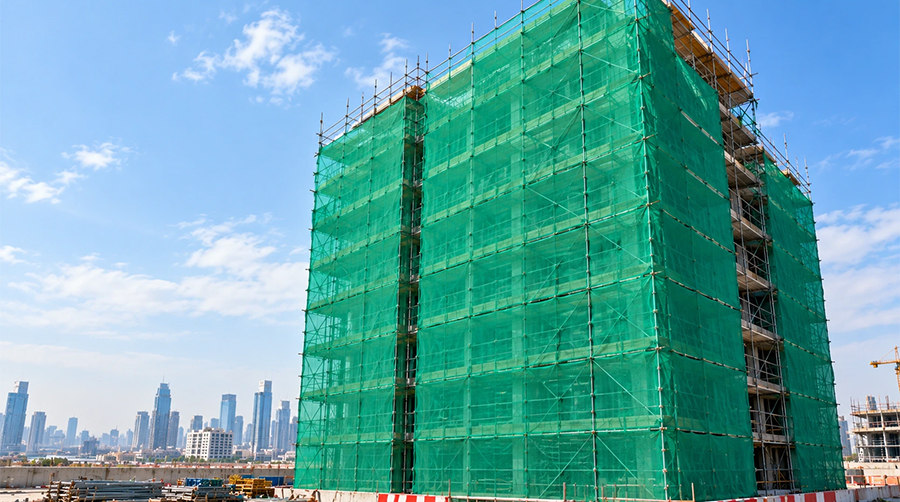
Green HDPE scaffold netting fixed to a high-rise scaffold to contain construction debris
Scaffold nets, also known as debris netting, are mesh materials attached to scaffolding to help contain loose construction debris and reduce the spread of dust. They are commonly manufactured from knitted high-density polyethylene (HDPE) or other polyethylene materials.
Their open-weave structure allows air to pass through, reducing wind resistance compared with solid sheeting. Depending on the mesh density, scaffold nets can also provide partial visual screening and help prevent small offcuts or loose materials from escaping the immediate work area.
Common colours include green, blue, black and white. The appropriate mesh, material quality and fixing arrangement depend on the project's containment needs, scaffold configuration and exposure to weather.
An important distinction is that debris netting is not a fall-arrest safety net. It is not designed to catch a falling person and must not replace guardrails, personal fall protection or a properly specified safety net system.
What Are Construction Tarpaulins?
Construction tarpaulins are sheets used to create temporary enclosures or protect work areas, materials and unfinished surfaces from weather and dust. They are commonly made from polyethylene (PE), PVC or laminated materials, with options for reinforced edges and eyelets to support fixing.
Unlike mesh netting, solid tarpaulins provide much greater resistance to rain and airborne dust. They can be used to enclose scaffolding during selected finishing activities, protect materials stored on site, and limit the spread of dust beyond a work area.
One specification to understand is GSM, or grams per square metre. It measures the material's weight per unit area and can help compare products of similar construction. A higher GSM may indicate a heavier material, but it does not automatically mean better performance. Reinforcement, coating, UV resistance, tear strength and fixing details also matter.
Scaffold Nets vs Tarpaulins: Key Differences
Although both materials can be attached to scaffolding, they behave differently in use. The main decision is whether a project needs airflow and debris containment or a more enclosed barrier against rain and dust.
| Feature | Scaffold nets | Construction tarpaulins |
|---|---|---|
| Material | Knitted HDPE or PE mesh | Solid PE, PVC or laminated sheeting |
| Airflow | Allows airflow through the mesh | Restricts airflow substantially |
| Wind-load impact | Generally lower than solid sheeting, depending on porosity | Generally higher and may require scaffold redesign |
| Rain protection | Limited | High, depending on material and installation |
| Dust containment | Helps reduce dust spread | Provides stronger containment when properly sealed |
| Visibility and light | Partial visibility and light transmission | Opaque or translucent options |
| Typical use | Debris containment, dust screening and visual barriers | Temporary enclosure, weather protection and finishing work |
The choice should be based on the actual site requirement rather than the assumption that one material can perform every function. Mesh may be more suitable where airflow is important, while solid sheeting may be appropriate where greater enclosure is needed. Both require a suitable scaffold design and fixing arrangement.
Why Dubai High-Rise Projects Need Both
High-rise construction creates risks that extend beyond the building itself. Loose tools, offcuts and construction debris can fall from elevated work areas onto lower levels, neighbouring properties, roads or pedestrian routes. In densely developed parts of Dubai, this makes effective containment and site housekeeping particularly important.
Weather conditions add another challenge. Dubai experiences very high summer temperatures, with daytime readings sometimes exceeding 40°C. Humidity can also be high, particularly in coastal areas, while northwesterly Shamal winds can bring blowing dust and sand. The UAE's National Center of Meteorology issues forecasts and warnings covering these conditions, including wind-related dust and reduced visibility.
These conditions affect how temporary enclosures should be planned. Dust can spread beyond the work area, wind can place additional loads on scaffolding, and heat and UV exposure can contribute to material deterioration.
Scaffold nets can help contain loose debris while maintaining airflow. Tarpaulins provide stronger protection where rain, dust or exposure during finishing work needs to be controlled. Using both in a planned arrangement can help address different risks across a project, provided the scaffold design accounts for the materials installed.
Neither product removes the need for proper edge protection, safe material storage, dust-control measures or routine site inspections.
Benefits of Scaffold Netting in Construction
Scaffold netting provides a practical layer of containment on construction and maintenance projects. Its effectiveness depends on mesh characteristics, installation quality, the type of debris involved and the surrounding site conditions.
Containing Falling Tools and Debris
Scaffold nets help contain small loose materials, offcuts and debris that could otherwise leave the work area. This is especially relevant where several floors are under construction or where activities take place above occupied areas.
However, netting should not be relied upon to stop every object. Heavy tools, large materials and poorly secured equipment require separate controls. Good housekeeping, toe boards, secure storage and safe handling practices remain essential.
The mesh must also be selected according to the size of debris likely to be generated. A material suitable for catching small offcuts may not contain larger or heavier objects.
Protecting Workers, Pedestrians and Neighbouring Property
On high-rise sites, falling-object hazards can affect workers below the active work area and people outside the construction boundary. Debris netting can reduce the chance of loose material escaping the scaffold when correctly selected and secured.
The benefits are particularly relevant to projects near roads, footpaths, commercial buildings and occupied properties. However, netting is only one element of a wider fall-prevention and falling-object control plan.
Debris netting must not be confused with personnel fall-arrest netting. Safety nets intended to catch falling people are designed and tested for that purpose. EN 1263-1 covers safety-net requirements and test methods, while EN 1263-2 addresses positioning limits. Project teams should specify a suitable certified system where personnel fall protection is required. BSI guidance on EN 1263-1
Reducing Dust and Improving Site Appearance
The mesh helps reduce the spread of some dust and loose particles from active work areas. It can also provide partial screening, creating a more orderly appearance around the building.
Its effectiveness depends on the mesh openings and the type of dust generated. Fine dust may pass through open mesh, so netting alone is unlikely to provide complete containment during activities that produce substantial airborne particles.
Where stronger containment is required, solid sheeting or additional dust-control measures may be more appropriate. The selected arrangement should consider ventilation, worker exposure, the surrounding environment and the scaffold's structural capacity.
Construction Site Weather Protection: How Tarpaulins and Nets Work Together
Scaffold nets and tarpaulins are useful for different aspects of temporary site protection. The right arrangement depends on whether the priority is airflow, debris containment, dust reduction, rain protection or creating a more enclosed work area.
Benefits of Tarpaulin Sheets on Construction Sites
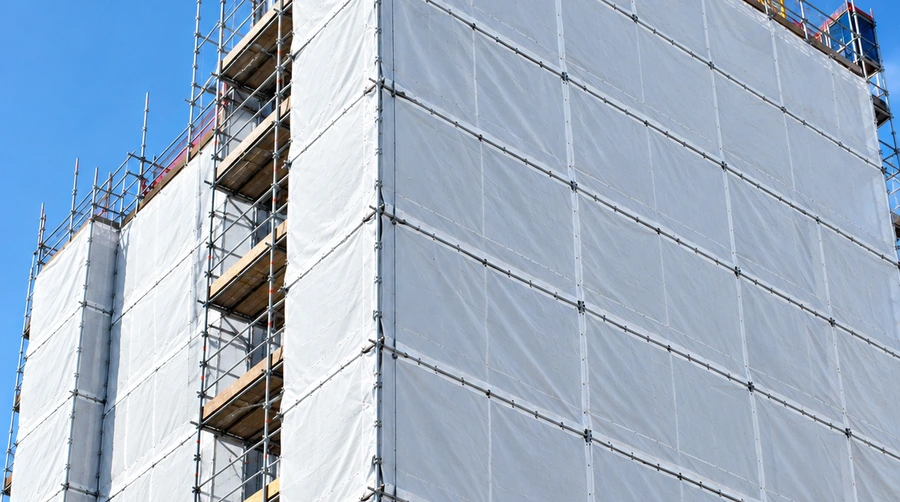
Tarpaulins provide a barrier against rain and can help protect selected materials, unfinished surfaces and work areas from weather exposure. They are also useful when finishing activities require a more controlled environment than open scaffolding can provide.
On suitable projects, tarpaulin sheets can help:
- Protect materials from rain and direct weather exposure.
- Reduce dust entering or leaving an enclosed work area.
- Shield selected finishing activities from light weather disruption.
- Provide temporary visual screening around active construction zones.
- Help protect equipment and stored materials when properly secured.
Their performance depends on material quality, seams, overlaps, UV resistance and the way the sheets are fixed. Tarpaulins do not eliminate the need for ventilation, drainage planning or protection against water accumulation.
Managing Wind, Heat and Dust
Solid sheeting significantly changes the way wind acts on a scaffold. Unlike open mesh, it blocks much of the airflow and can create greater pressure on the scaffold, its ties, anchors and supporting structure.
This is particularly important on high-rise buildings and exposed sites around Dubai. Shamal winds and other strong wind events can place additional demands on temporary structures. A scaffold designed for open conditions cannot automatically be assumed suitable once it is enclosed with tarpaulins.
Before adding solid sheeting, the scaffold designer or responsible temporary works engineer should assess the revised wind loads and confirm whether the existing ties, anchors, bracing and supporting arrangement remain adequate.
Mesh netting generally allows more airflow, but the degree of wind reduction depends on its porosity, dimensions and installation. It also offers less protection from wind-driven rain and fine dust.
Heat needs consideration too. Solid enclosures can reduce ventilation and allow heat to build up within the work area. The design should account for worker comfort, ventilation needs and the nature of the work being performed.
Do Tarpaulins Protect Scaffolding from Wind and Rain?
Tarpaulins can provide protection against rain and UV exposure, depending on the material and its specifications. However, they do not automatically protect the scaffold from wind. Solid sheeting can increase wind loads and may make the scaffold more vulnerable if the structure has not been designed for the enclosed arrangement.
Secure fixings alone are not enough to establish structural suitability. The scaffold and its anchorage system must be assessed for the expected loads and site exposure.
Scaffold nets offer greater airflow but do not fully prevent rain from reaching the work area. The appropriate choice depends on the level of enclosure required, the local wind conditions and the design of the temporary structure.
Safety, Fire Rating and Compliance on Dubai High-Rise Sites
Netting and sheeting should be treated as part of the temporary works arrangement, not simply as materials attached to the scaffold after erection. Their specifications, fixing methods and maintenance affect both site safety and scaffold performance.
Fire-Retardant Materials and Test Certificates
Construction sites may specify fire-retardant scaffold netting or sheeting, particularly where the scaffold is close to occupied buildings, public areas or activities that introduce ignition risks.
Ask the supplier for relevant third-party test certificates and confirm that the documentation applies to the exact material and product being proposed. NFPA 701 is a commonly referenced test method for the flame propagation of textiles and films. The applicable test method depends on the product and its characteristics.
Do not assume that every material marketed as fire-retardant meets the project's requirements. Check the product identification, test documentation, intended application and any additional requirements specified by the consultant, client or relevant authority.
Fire-retardant performance also does not mean a material is fireproof. Safe storage, hot-work controls, ignition-source management and emergency arrangements remain necessary.
Wind Load, Anchoring and Fixing
Adding sheeting changes the scaffold's exposure to wind. The revised arrangement may require changes to the design, including ties, anchors or bracing. The required measures depend on scaffold height, location, building geometry, wind exposure and the material's resistance to airflow.
Netting and tarpaulins should be secured using suitable fixings at the locations and spacing specified for the system. Loose edges, damaged eyelets, missing ties and improvised attachments can compromise the installation.
Any significant change from the approved scaffold arrangement should be reviewed before the material is installed or the scaffold is returned to use.
Inspection and Replacement
Netting and sheeting need routine inspection throughout their service life. Strong winds, prolonged UV exposure, abrasion and handling can cause deterioration even when the material initially meets the specification.
Inspections should check for:
- Tears, holes, frayed edges and damaged seams.
- Loose ties, clips, eyelets or other fixings.
- Signs of UV degradation or material brittleness.
- Accumulated debris or material that could create additional loads.
- Changes to the scaffold or enclosure that affect stability.
After strong winds or other adverse weather, inspect the installation before normal work resumes, following the project's inspection procedures. Damaged sections should be repaired or replaced as appropriate, and any scaffold stability concern should be addressed before the area is used again.
Understanding UAE Requirements
Dubai projects must follow the applicable construction safety requirements, project specifications and authority directions. Dubai Municipality lists the Safety Guide for Construction Works in the Emirate of Dubai, approved under Administrative Resolution No. 112 of 2026, among its current legislation and guidance resources. Dubai Municipality: Laws and Legislations
Requirements for temporary netting and sheeting can depend on the project, location, risk assessment and specified materials. Do not assume that one fire-rating standard or product certificate automatically satisfies every project or authority requirement. Confirm the current specifications with the project team and relevant authority before procurement and installation.
How to Choose the Right Scaffold Nets and Tarpaulins
Selection should begin with the intended function and site exposure. Product weight or colour alone cannot establish whether a material is suitable for a high-rise scaffold.
| Criterion | Scaffold nets | Tarpaulins / sheeting | What to check for Dubai projects |
|---|---|---|---|
| Mesh or porosity | Open mesh, with openings selected for containment needs | Solid material | Balance airflow, dust control and wind exposure |
| Material and GSM | Knitted HDPE or PE; compare product specifications | PE or PVC laminated sheets; compare product specifications | Check durability, reinforcement and intended exposure |
| Fire rating | Fire-retardant grade where specified | Fire-retardant grade where specified | Request valid certificates for the exact product |
| UV stabilisation | Important for prolonged outdoor use | Important for prolonged outdoor use | Consider intense sunlight and expected exposure |
| Size and fixings | Rolls secured using suitable clips or ties | Rolls with reinforced edges, eyelets or specified ties | Confirm secure fixing and suitability for wind loads |
| Colour | Commonly green, blue, black or white | White, translucent or coloured options | Consider visibility, screening and site requirements |
| Expected lifespan | Depends on material quality, UV exposure and handling | Depends on material quality, UV exposure and handling | Use manufacturer guidance and inspect regularly |
Some products are marketed with GSM ranges, mesh dimensions or estimated service lives. These should be treated as product-specific guidance rather than universal standards. The correct specification depends on the material, construction, exposure and performance required.
Before selecting a product, confirm the following:
- Purpose: Is the primary need debris containment, dust control, rain protection, visual screening or a temporary enclosure?
- Wind exposure: Has the scaffold design accounted for the proposed netting or sheeting?
- Fire performance: What fire-rating documentation does the project require?
- Fixing method: Are the edges, eyelets, clips and ties suitable for the installation?
- Site conditions: How long will the material remain exposed to sunlight, wind, dust and handling?
- Inspection plan: Who will inspect the material, and how will damage be reported and rectified?
These checks help project teams select a material based on actual performance requirements rather than price or appearance alone.
Frequently Asked Questions
How do scaffold nets protect high-rise construction sites?
Scaffold nets help contain loose debris and offcuts, reduce the spread of some dust and provide partial screening around elevated work areas. They can help protect people and property below, but they do not replace guardrails, safe material handling or fall-arrest systems designed to protect workers.
What is the difference between scaffold nets and tarpaulins?
Scaffold nets are open mesh materials that allow airflow while helping contain debris and some dust. Tarpaulins are solid sheets that provide greater resistance to rain and airborne dust. Tarpaulins also create higher wind loads on scaffolding, so their use requires appropriate design checks.
Do tarpaulins protect scaffolding from wind and rain?
Tarpaulins can protect enclosed areas from rain and sunlight, depending on their specifications and installation. They do not automatically protect scaffolding from wind. Because solid sheeting increases wind resistance, the scaffold and its anchorage must be assessed for the revised loads before installation.
Why are scaffold nets used on high-rise buildings?
Scaffold nets are used on high-rise buildings to help contain loose construction debris, reduce dust spread and provide partial visual screening. These functions are particularly useful where elevated work takes place above pedestrian routes, roads or neighbouring properties. Netting must be selected and fixed for the intended use.
How can you protect high-rise construction from dust and weather?
Start by assessing the work, surrounding properties and weather exposure. Scaffold nets can help reduce debris and some dust, while suitable tarpaulins provide stronger enclosure against rain and airborne dust. The scaffold design, fixing arrangement, ventilation and inspection plan must account for the selected materials.
Planning Safer, Better-Protected High-Rise Sites
Scaffold nets and tarpaulins serve different purposes, and selecting the right arrangement requires more than choosing a mesh or sheet. Project teams need to consider debris containment, dust control, weather exposure, fire-rating requirements and the additional wind loads created by enclosure materials.
For high-rise projects in Dubai, the starting point is to match the material to the site risk and confirm that the scaffold is suitable for the proposed arrangement. Coordinate the selection with the scaffold designer, temporary works team and site safety personnel before installation. For project teams planning related temporary works, contact Quad Dream to discuss the wider access and site-planning requirements.


