



Table of Contents
- What Is Scaffolding?
- What Is Shoring?
- Shoring vs Scaffolding: Key Differences
- Why Do Shoring and Scaffolding Get Confused?
- When Do You Need Structural Support Instead of Scaffolding?
- Limitations of Access Scaffolding on High-Rise Projects
- Temporary Works in the UAE
- Common Mistakes to Avoid
- Frequently Asked Questions
- Not Sure Which System Your Project Needs?
Shoring vs Scaffolding: Key Differences and When You Need Structural Support
Scaffolding is a temporary platform that lets workers reach and work at height safely. Shoring is a temporary structural support that carries loads or resists earth pressure, so a structure or excavation stays stable. In simple terms, scaffolding supports people, while shoring supports the structure.
The two are often confused because both can use steel components, standards, frames, braces, and other temporary works equipment. However, they perform very different functions and are designed for different loads. Understanding the difference matters when planning construction access systems, structural alterations, excavation works, or concrete placement.
This guide explains the key differences between shoring and scaffolding, when each system is required, where access scaffolding has limitations, and what UAE project teams need to consider when planning temporary support systems.
What Is Scaffolding?
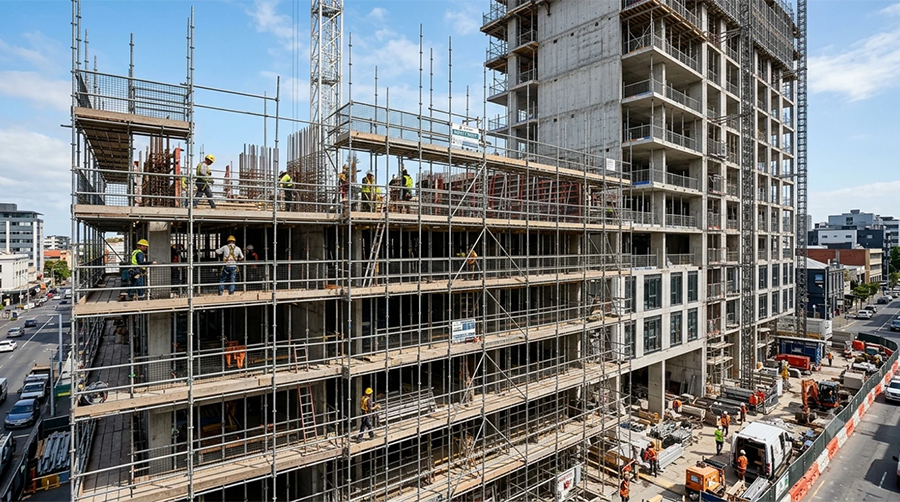
Scaffolding is a temporary structure used to provide workers with safe access and working platforms at height. It allows construction, maintenance, installation and finishing activities to be carried out safely around structures and in areas that are difficult to reach from ground level.
Common scaffolding systems include Cuplock scaffolding and aluminium mobile towers, each suited to different access requirements. In UAE construction, scaffolding is commonly used for façade work, high-rise construction, MEP installation, painting, cladding and industrial maintenance.
What Is Shoring?
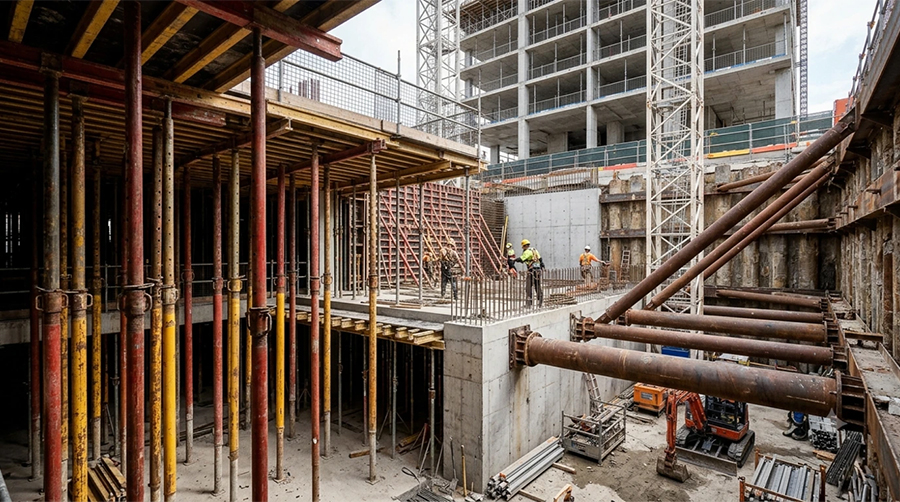
Shoring is a temporary support system used to stabilize a structure, excavation or structural element when it cannot safely support the required loads on its own. It provides temporary support during construction, alteration, demolition or other temporary works.
Common shoring systems include vertical shoring or falsework, raking and flying shores, excavation shoring, and façade retention systems. The arrangement selected depends on the structural or ground conditions, loads involved and construction sequence.
Shoring must be designed and checked by a qualified engineer because the system needs to safely support the specific loads and conditions of the project.
Shoring vs Scaffolding: Key Differences
The main difference between shoring and scaffolding is their purpose. Scaffolding is primarily a construction access system, while shoring provides temporary structural support or resists earth pressure.
| Feature | Scaffolding | Shoring |
|---|---|---|
| Main purpose | Safe access for people | Structural support for loads or earth pressure |
| What it carries | People, tools, limited materials | Weight of structure, concrete or soil |
| How loads reach the ground | Through standards and ties | Direct transfer into ground or permanent structure |
| Design responsibility | Scaffold designer / competent person | Qualified structural / temporary works engineer |
| When it is removed | After access work finishes | After engineer confirms required strength |
| Typical UAE use | Façade, finishing, MEP, maintenance | Slab support, deep excavation, façade retention |
Why Do Shoring and Scaffolding Get Confused?
The confusion usually comes from their appearance. Both systems can contain vertical members, horizontal members and bracing, and both are temporary structures assembled on construction sites. Their engineering purpose, however, is different.
Access scaffolding is designed around working platforms and their permitted loads. Wet concrete and structural loads can be substantially higher. A standard access scaffold must therefore never be treated as shoring simply because it appears strong enough. If scaffolding is required to support structural loads, it must be specifically designed and verified for that purpose.
When Do You Need Structural Support Instead of Scaffolding?
The decision depends on what the temporary system needs to do. Four questions can help establish whether the requirement is for access or structural support.
Is Something Heavy Being Held Up?
If the temporary system needs to support wet concrete, slabs, beams, or another structural element, structural support is required. Access scaffolding is not automatically designed for these loads.
Is Soil or Water Pressure Being Resisted?
Excavation work can create pressure from surrounding soil and, depending on the site, groundwater. Shoring may be required to maintain excavation stability and protect workers, nearby structures and surrounding areas.
Is a Structure Being Altered or Partly Demolished?
Structural alterations and partial demolition can temporarily change how loads are transferred through a building. Shoring may be needed while a structural element is removed, modified or replaced.
Do People Only Need Access at Height?
If workers simply need a safe platform to carry out façade repair, cladding, painting or installation work, access scaffolding may be the appropriate system.
Shoring may be required for:
- Wet-concrete slab support
- Deep excavation
- Structural alterations
- Façade retention
- Temporary support during demolition
Scaffolding may be required for:
- Façade repair
- Cladding installation
- Painting
- MEP installation
- Maintenance
Some projects require both systems. For example, slab construction may require shoring to support the formwork and wet concrete, while a separate access scaffold may be required to provide workers with safe access to the work area.
Never use access scaffolding as shoring without an engineered design.
Limitations of Access Scaffolding on High-Rise Projects
Access scaffolding has specific limitations that become increasingly important as building height and site exposure increase.
Ties and Anchor Points
External scaffolding may depend on reliable ties to the building or other engineered connections. The location and capacity of these connections need to be considered during scaffold design.
Wind Loads
Wind exposure generally becomes a more significant consideration at greater heights. The scaffold, ties and supporting arrangement need to be suitable for the site conditions.
Working-Load Limits
Scaffold platforms have defined load capacities. Materials, tools and equipment must remain within the permitted working load rather than being treated as structural storage platforms.
Ground Bearing
The scaffold transfers loads through its supporting arrangement to the ground or supporting surface. The condition and bearing capacity of that surface must be suitable for the proposed scaffold.
Formwork Support
Access scaffolding cannot simply replace formwork support. Slabs, beams, and wet concrete require a temporary support system designed for the relevant structural loads.
These limitations are particularly relevant to high-rise projects where wind exposure, building geometry, access requirements and site conditions can significantly affect the temporary works arrangement.
Temporary Works in the UAE
Temporary works form an important part of construction planning because they provide stability and support while permanent construction is incomplete. The applicable design, inspection and approval requirements depend on the type of temporary works, project location and authority requirements.
For scaffolding, EN 12811 provides requirements and performance criteria for temporary works equipment used in construction. EN 12812 covers falsework and provides performance requirements and general design principles.
UAE projects must also comply with the requirements applicable to their specific emirate and project jurisdiction. Dubai projects may be subject to Dubai Municipality requirements, while projects in Abu Dhabi fall under the Abu Dhabi Occupational Safety and Health System Framework (ADOSH-SF). Project-specific requirements may also come from the client, consultant or relevant authority.
Local conditions also need to be considered. Heat and humidity can affect equipment condition and working practices, while corrosion can be a consideration in exposed or coastal environments. Sandy or variable ground conditions require appropriate attention to the scaffold base and ground bearing. Wind loads are also an important consideration for elevated external scaffolding.
Temporary works should therefore be planned, designed and supervised according to the actual project conditions rather than relying on a standard arrangement.
Common Mistakes to Avoid
Several mistakes can occur when access scaffolding and structural support are treated as interchangeable:
- Using access scaffolding as shoring without an engineered design
- Setting up scaffolding without adequately considering ground bearing
- Missing required bracing or ties
- Removing shoring before the structure has achieved the required strength
- Poor coordination between the main contractor, structural engineer and specialist contractors
The first step is always to establish whether the temporary system is intended for access, structural support, or both.
Frequently Asked Questions
1. What is the main difference between shoring and scaffolding?
Scaffolding provides safe access for people to work at height. Shoring provides temporary structural support for loads or earth pressure. In simple terms, scaffolding supports workers and their working platforms, while shoring supports the structure or ground.
2. Can scaffolding be used as shoring?
Only if it has been specifically engineered and designed as shoring or falsework. Standard access scaffolding is not designed to carry slab or structural loads and should never be used for that purpose without proper engineering and verification.
3. When do you need shoring instead of scaffolding?
You need shoring when the temporary structure must carry significant loads or resist earth pressure. Typical cases include supporting wet concrete, deep excavations, structural alterations, demolition activities, or retaining an existing façade during construction.
4. Is shoring the same as formwork or falsework?
No. Formwork, or shuttering, is the mould that shapes fresh concrete. Shoring or falsework provides temporary support to the formwork and loads until the permanent structure can safely support itself. The systems perform different functions within the temporary works arrangement.
5. What are the limits of access scaffolding on tall buildings?
Access scaffolding has clear limits on high-rise projects. Its design depends on reliable ties and suitable foundations, while increasing height can increase wind loads. Platform loading must remain within its designed capacity, and scaffolding cannot replace engineered formwork support.
Not Sure Which System Your Project Needs?
Choosing between access scaffolding and structural support starts with understanding what the temporary system needs to achieve. Quad Dream advises on access scaffolding requirements, while structural support, shoring and falsework should involve a qualified temporary work or structural engineer.
For a scaffolding enquiry, provide your project type, working height, access areas, expected loads, site conditions and required timeline. These details help establish the access requirements and the appropriate scaffolding arrangement for the project.
Contact Quad Dream to discuss your scaffolding requirements.


