



Table of Contents
2. Why Equipment Selection at Height Is a Compliance Decision, Not Just a Logistics One
3. Height Access Equipment Types: What Each Is Built For
4. Side-by-Side Comparison: Matching Equipment to Project Conditions
5. Key Decision Factors UAE Site Managers Must Confirm Before Booking
6. Industry-Specific Access Challenges That Change the Equipment Decision
7. Common Mistakes UAE Contractors Make When Selecting Height Access Equipment
8. What a Construction Equipment Supplier in the UAE Should Be Providing But Often Isn't
9. Pre-Rental Checklist: What to Confirm Before Booking Any Height Access Equipment
10. Frequently Asked Questions
11. Get the Specification Right Before the Machine Hits Site
Working at Height in UAE Construction: Cradle, Manlift, Scissor Lift, or Scaffold: How to Choose the Right Equipment
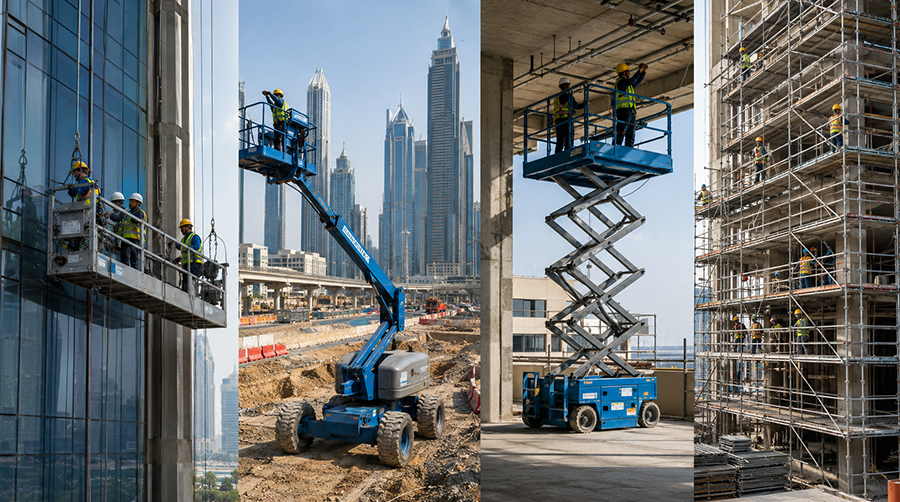
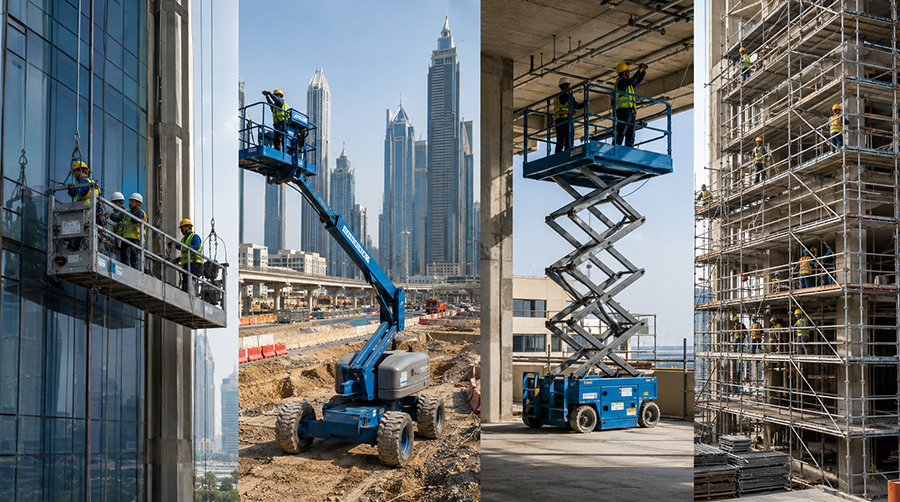
For high-rise facade work, a suspended access cradle is the only structurally viable option. Manlifts suit irregular terrain and outdoor heights above 12 metres. Scissor lifts are built for flat, indoor horizontal access. Scaffolding is the correct choice when multiple trades need concurrent platform access over an extended programme. The decision variable is not height alone. It is the combination of access geometry, surface conditions, project duration, and trade overlap.
Why Equipment Selection at Height Is a Compliance Decision, Not Just a Logistics One
OSHAD-SF CoP 26 ties platform selection directly to site-specific risk assessment. The equipment type chosen affects what method statement can be approved and whether your insurance cover holds in the event of an incident. Dubai Municipality Technical Guidelines add a further layer. Certain equipment requires permit submission before site deployment. When the wrong equipment is used and an incident occurs, liability does not sit only with the operator. It extends to the main contractor who approved the access method.
Height Access Equipment Types: What Each Is Built For
Each of these four equipment categories has a defined operational envelope. Selecting outside it does not just create inefficiency. It creates a compliance exposure that method statement approval will not protect against.
Suspended Access Cradles for High-Rise Facade Work in UAE
For curtain wall installation, cladding, and facade maintenance on towers in DIFC, Dubai Marina, and Saadiyat Island, a cradle is the only system that follows the facade geometry at height without a ground-supported structure. Load capacity and wind speed limits are set by the building engineer, making cradle selection a structural decision before it is an access one.
Boom Lift and Manlift Rental UAE: When to Specify
Articulated boom lifts suit confined outdoor sites with obstructions. Telescopic variants work on open sites where reach is the primary variable. Diesel for outdoor UAE sites, electric for LEED-certified or enclosed environments. Operator certification under OSHAD-SF is mandatory before the machine enters site. A manlift does not replace scaffold on multi-day, multi-trade work.
Scissor Lifts: Default Choice for Indoor Horizontal Access, not a Universal Solution
Built for flat, hard indoor surfaces. Primary UAE use cases are MEP installation, fit-out, false ceiling work, and slab-to-slab access in developments like Business Bay. The most consistent misuse is deployment on uneven or soft ground. Slab load rating must be confirmed before indoor deployment, not assumed.
Scaffolding: When Fixed Platform Duration Justifies the Setup Investment
Scaffolding is the correct specification when a structure needs to support concurrent trades over multiple programme phases. For extended multi-phase construction, such as hotel and high-rise residential projects, scaffold systems allow concurrent trade access that no mobile platform can replicate.
See Quad Dream's project portfolio for examples of how this has been applied across UAE construction and industrial scopes. System scaffold suits high-rise and structural work. Tube-and-fitting suits irregular geometry where a modular grid cannot follow the building form. Erectors must hold OSHAD-SF competency certification and third-party inspection records must be maintained throughout. For short-duration, single-trade tasks, scaffolding creates more programme overhead than it solves.
Side-by-Side Comparison: Matching Equipment to Project Conditions
- High-rise facade cladding, Dubai Marina: Cradle rental
- MEP installation, fit-out project, Business Bay: Scissor lift
- Multi-trade construction, slab to slab, Jebel Ali: Scaffold
- Irregular terrain, outdoor infrastructure work: Articulated boom lift
Key Decision Factors UAE Site Managers Must Confirm Before Booking
- Height, Access Geometry, and Facade Conditions
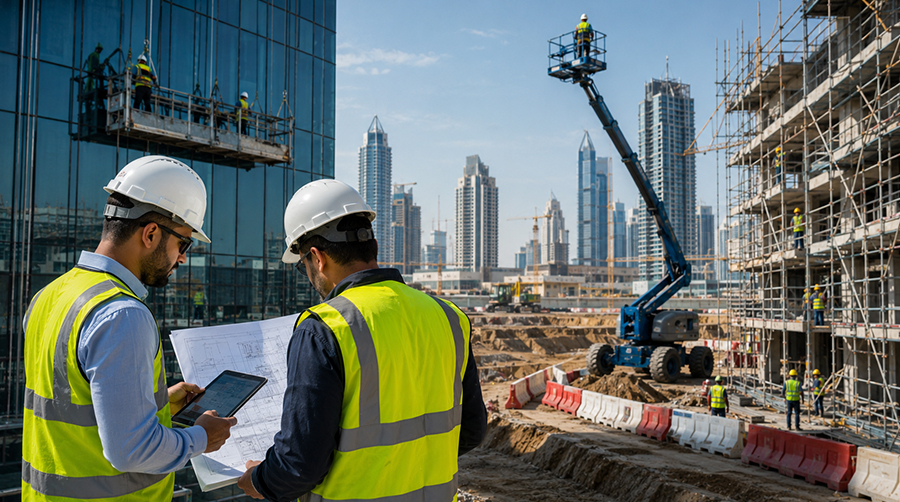
Vertical height is the starting point, not the conclusion. Access angle, facade setbacks, and building geometry determine whether the machine can physically reach the working face. At heights above 43 metres, manlifts are no longer viable and the decision shifts to cradle or scaffold depending on whether the access is fixed or travelling. Wind load assessment for cradle systems on a specific tower is the structural engineer's responsibility. This must be completed and documented before operational planning begins. - Ground and Surface Conditions
Dubai site conditions near excavations and recently backfilled areas require outrigger ground pressure assessment before any boom lift is positioned. Soft or unstable ground beneath outrigger pads is a common cause of manlift instability on UAE infrastructure and civil works projects. For scissor lift deployment in fit-out and MEP environments, slab load ratings must be confirmed against the machine's axle load, not its platform capacity. - Duration, Trade Overlap, and Mobilisation Cost
At around the five-day mark, the cost equation between repeated mobile equipment rental and a scaffolding package begins to shift. When two or more trades need simultaneous access to the same face or floor level, scaffold almost always produces a lower total cost when mobilisation, demobilisation, and idle time are included. Mobilisation cost is consistently underestimated in short-duration bookings for cradles and scaffold. - Regulatory Compliance and Permit Requirements
Operator certifications required under OSHAD-SF are the contractor's responsibility to verify on site, not the rental company's. Dubai Municipality requires permit submission for certain equipment types before deployment and this lead time must be factored into the programme, not treated as a same-day process. Equipment type directly affects what a method statement can include. If the method statement specifies a scissor lift on outdoor ground and the surface assessment shows otherwise, the risk assessment sign-off will not hold.
Quad Dream's QHSE framework covers equipment inspection and compliance documentation across all rental categories.
Industry-Specific Access Challenges That Change the Equipment Decision
- Construction and Real Estate: Multi-trade phasing on high-rise residential and commercial towers requires platform solutions that allow concurrent access without trade conflict. Slab load constraints on upper floors limit scissor lift options and facade access above podium level typically requires scaffold or cradle, not mobile platforms.
- Oil and Gas: Explosion-proof equipment classification is mandatory in classified zones. Hot work permit requirements affect which platform types can operate in proximity to live plant. Equipment that is not zone-rated cannot enter these environments regardless of height or duration requirements.
- Marine and Offshore: Corrosion-rated equipment specification is non-negotiable in marine environments. Tidal variation and vessel movement affect cradle and platform access windows. Confined space considerations add a further layer to access method selection that standard construction equipment rental does not address.
- Infrastructure and Utilities: Uneven terrain, overhead obstruction from existing services, and extended outdoor duration across open sites make articulated boom lifts the most common choice, but outrigger ground stability assessments remain essential before deployment.
Common Mistakes UAE Contractors Make When Selecting Height Access Equipment
- Defaulting to scaffolding for short-duration single-trade tasks: The mobilisation and dismantling time adds programme days that were not costed. For a single-trade task under five days, a manlift or scissor lift is almost always the more efficient and cost-effective solution.
- Using scissor lifts on unprepared, sloped, or soft ground: This is the leading cause of scissor lift incidents on UAE sites. The machine is not designed for this environment and OSHAD-SF non-compliance from tip-over risk is immediate. Ground assessment is not optional.
- Booking manlifts without confirming operator certification: Site access refusal at the gate is the best-case outcome. Liability for an uncertified operator on a DM-regulated site falls directly on the main contractor who approved the access method.
- Selecting cradle systems without a wind speed assessment for the specific tower: Operational shutdown mid-project due to wind exceedance is both a safety incident and a programme failure. The assessment must happen before installation, not during operations.
- Treating all scissor lifts as interchangeable regardless of slab load rating: Deploying a machine with an axle load that exceeds the slab rating voids structural insurance and can cause structural damage that far exceeds the cost of the original access requirement.
What a Construction Equipment Supplier in the UAE Should Be Providing But Often Isn't
Equipment rental in UAE construction operates almost entirely as a transaction. A machine is requested, a machine is delivered, and what happens on site is the contractor's problem. That model is not aligned with what OSHAD-SF actually requires from a compliant rental operation.
A qualified construction equipment supplier should arrive at a site assessment with an understanding of the access challenge, not just a catalogue. Operator certification verification, method statement support, compliance documentation, and pre-deployment inspection are not extras. They are part of what a rental engagement in a regulated construction environment should include as standard.
The gap between what the heavy equipment rental market typically delivers and what the regulatory framework actually demands is where most compliance exposures are created, not on site but at the point of booking.
The correct equipment for the right site, delivered with the documentation to prove it, is not a premium service. It is the minimum standard.
Pre-Rental Checklist: What to Confirm Before Booking Any Height Access Equipment
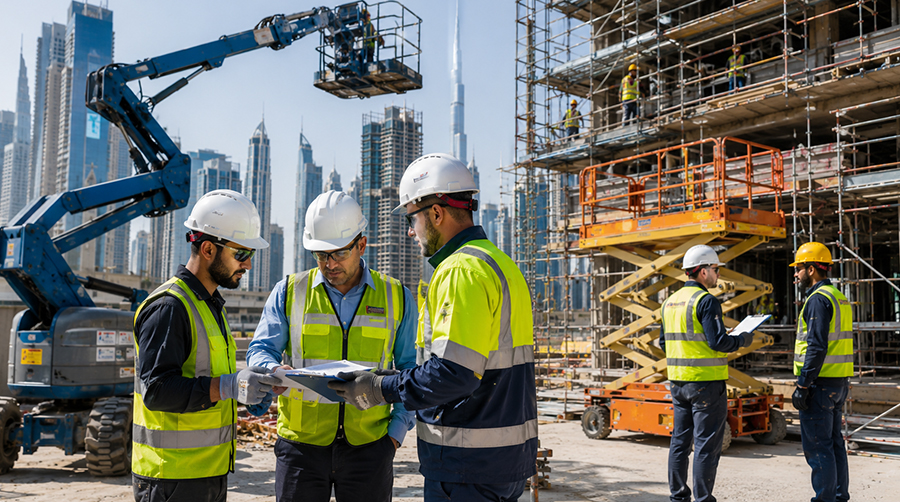
- Before any height access equipment is booked, confirm the following:
- Site ground condition assessed and documented?
- Operator certification verified for the specific equipment type?
- Method statement and risk assessment prepared and approved?
- Dubai Municipality or OSHAD-SF permit obtained where required?
- Third-party inspection scheduled for cradle systems and scaffolding?
- Slab load rating confirmed for any indoor scissor lift deployment?
- Wind speed operational limit assessed for cradle system installation?
- Mobilisation and demobilisation timeline factored into the programme schedule?
Quad Dream's team provides pre-rental site assessments to confirm the right equipment specification before booking.
Frequently Asked Questions
1. What is the maximum safe working height for a scissor lift on a UAE construction site?
Electric scissor lifts reach a maximum working height of approximately 16 metres. OSHAD-SF requires a risk-assessed platform with guardrails and a documented method statement at any working height above 2 metres. Above 16 metres, a manlift or scaffold becomes the appropriate specification depending on terrain and access geometry.
2. Do manlift operators need a specific licence or certification in the UAE?
Yes. OSHAD-SF requires operators of boom lifts and manlifts to hold a recognised competency certification for the specific equipment category. On site, it is the main contractor's responsibility to verify operator certification before the machine is put into use. The rental company's delivery obligation ends at the machine.
3. When does scaffolding become more cost-effective than a manlift rental in Dubai?
At approximately the five-day mark, the combined cost of manlift hire, mobilisation, and demobilisation typically reaches parity with a scaffold package. For multi-trade access requirements where two or more contractors need simultaneous platform use, scaffolding is almost always the more economical solution regardless of duration.
4. What wind speed restrictions apply to suspended access cradles in Dubai?
Operational wind speed limits for cradle systems are specified by the structural engineer for the specific building, not set as a universal industry figure. Most systems are restricted to operational use below 12.5 metres per second. Non-compliance mid-project results in an immediate operational shutdown and requires a formal restart assessment before operations can resume.
5. How do I verify a scaffolding company in the UAE is OSHAD-SF compliant?
Request the company's scaffold erector competency certificates, third-party inspection records, and their QHSE management documentation. An OSHAD-SF compliant scaffolding company maintains a scaffold register on every project and can provide stamped engineering drawings for any structure above defined height thresholds. Quad Dream's QHSE documentation is available on request.
Get the Specification Right Before the Machine Hits Site
Equipment selection at height is a risk and compliance decision before it is a cost one. Getting it wrong on a UAE project does not just affect the day rate. It affects the method statement, the permit, the insurance position, and in the worst case, the programme and the people on it. The right equipment, confirmed against the actual site conditions and regulatory requirements before booking, is what makes the rest of the access plan work. Quad Dream operates as a consultative rental and contracting partner across scaffolding and construction equipment, supporting site teams from specification through to compliant delivery.


