



Table of Contents
- Access Challenges in UAE Industrial Plant Maintenance
- What Modular Aluminium Scaffolding Is, and What It Is Not
- Why Modular Aluminium Systems Are Preferred in Suitable Industrial Applications
- Where Modular Aluminium Scaffolding Is Used in Plant Maintenance
- Safety, Environmental and Selection Considerations in the UAE
- Frequently Asked Questions
- Choosing the Right Access System for Your Facility
In a working plant, access is rarely simple. Equipment cannot stay offline for long, the space around pumps, ducts, and pipe racks is tight, and the same inspection or repair job comes round again on a fixed cycle. Every hour spent putting up and taking down access is an hour counted against maintenance time.
That is why one question comes up regularly: why modular aluminium scaffolding for industrial facilities? This article explains why aluminium modular access is often chosen in these conditions, where it works well, and where it does not. The aim is a practical answer for the people who plan and carry out plant maintenance, with honest limits attached.
Access Challenges in UAE Industrial Plant Maintenance
Plant maintenance in the UAE puts specific demands on access equipment before any product is chosen.
Restricted Access Around Machinery, Pipework and Overhead Services
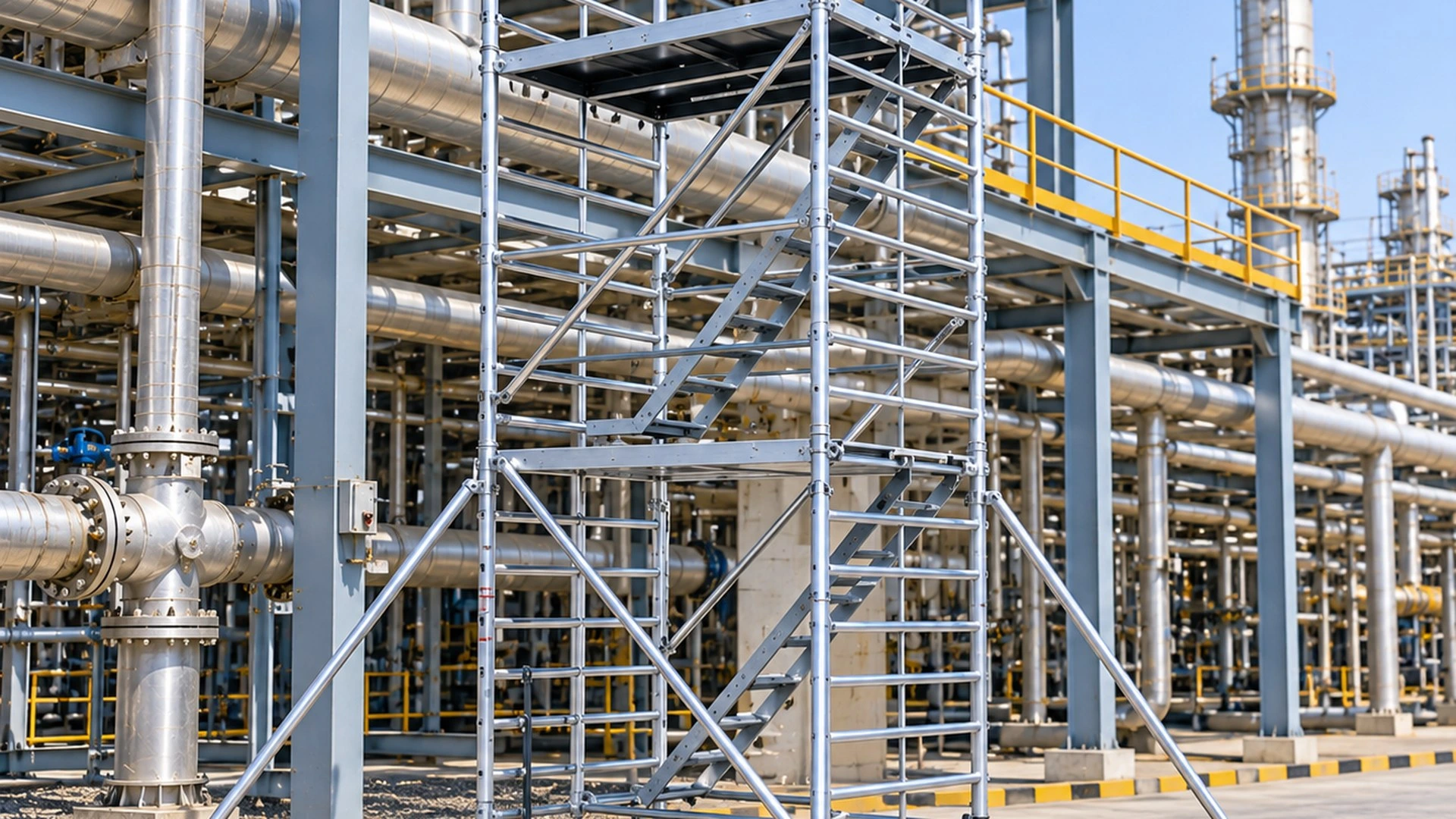
Access on a plant floor means building platforms beside pumps, motors, ducts, cable trays, conveyors, and pipe racks, often in confined or restricted areas. Equipment has to be carried in, assembled around obstacles, and sometimes moved more than once. Long or heavy components are hard to get through hatches, stairwells, and narrow aisles
Shutdown Windows and Routine Inspection Cycles
Maintenance is time-boxed. Routine inspections follow a cycle, and planned shutdowns have fixed start and end dates. The longer access takes to erect and strike, the more it counts against maintenance downtime, so the speed and simplicity of the access system matter for both inspections and shutdowns
What Modular Aluminium Scaffolding Is, and What It Is Not
Modular scaffolding is built from prefabricated components that connect in a fixed, standardised way. Most modular systems are steel, but aluminium versions and aluminium components such as decks, stairs, and beams exist. Layher, for example, lists an aluminium version of its Allround system among its approvals, and Doka's Ringlock offers stairways in steel or aluminium.
Not every aluminium scaffold is modular. Mobile aluminium towers are a separate product with their own standard and limits.
Modular Systems vs Mobile Aluminium Towers
| Type | Typical use | Governing standard | Key point |
|---|---|---|---|
| Modular scaffolding system | Larger access structures built around plant and equipment | EN 12810 and EN 12811 | Fixed-geometry components assembled into a structure designed for the site; competent erection required |
| Mobile aluminium tower | Light, repositionable access for inspection, servicing, and installation tasks | EN 1004-1 | Free-standing and wheeled; covers towers up to 12 m indoors and 8 m outdoors and excludes scaffolds under EN 12810 and EN 12811 |
Specifications for one should never be applied to the other.
Why Modular Aluminium Systems Are Preferred in Suitable Industrial Applications
Aluminium modular access is preferred where weight, handling, repeated repositioning, and corrosion exposure matter more than extreme load capacity. In those suitable applications, the advantages show up in real maintenance situations, as the points below describe.
Lighter Components for Handling, Access Routes and Manual-Handling Risk
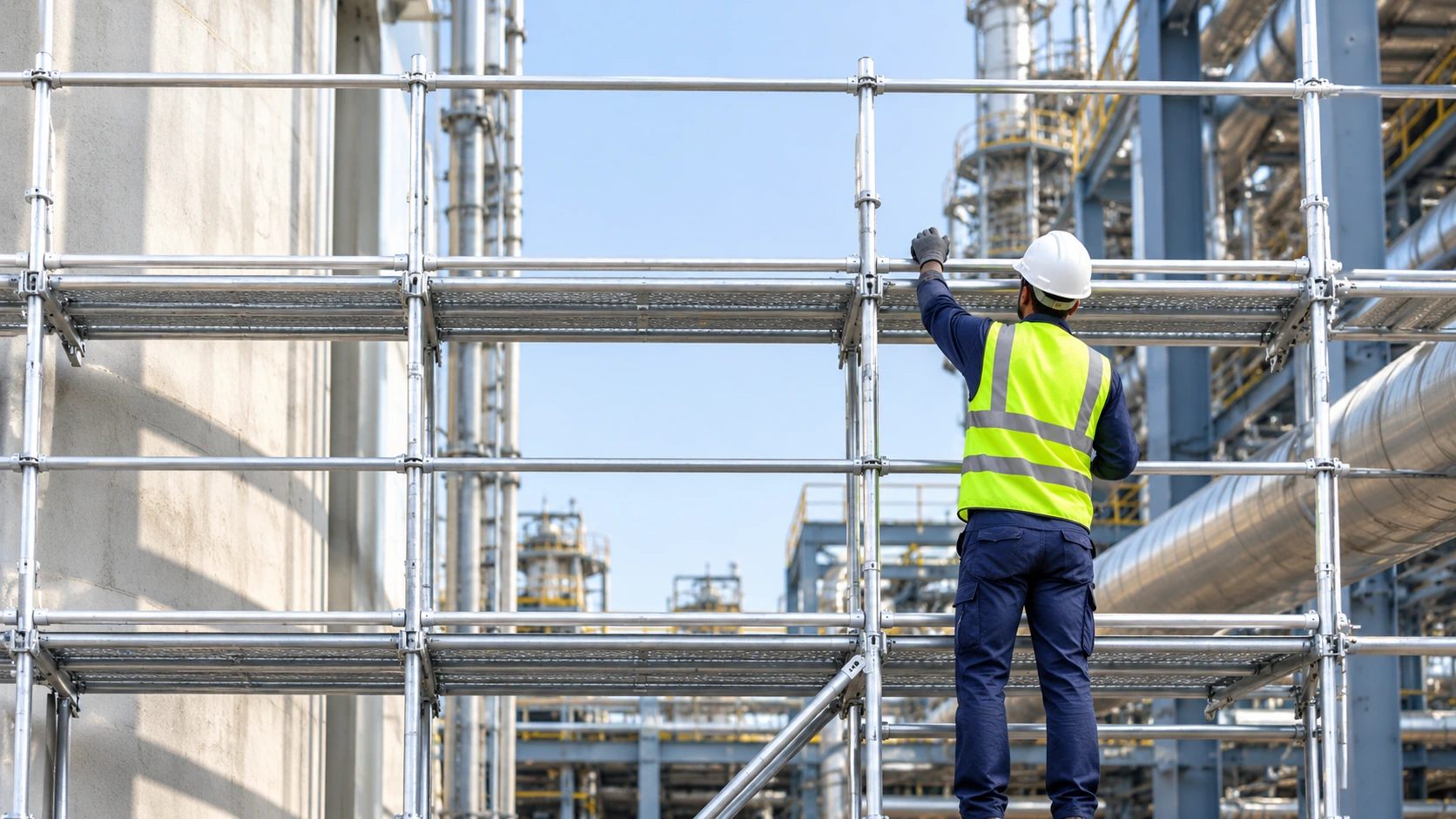
Aluminium's density is about one third that of steel. In practice, components can be carried by hand through narrow routes, stairs, hatches, and manholes, and a scaffold can be built without bringing lifting plant into a crowded area. Lighter parts also reduce manual-handling strain, a genuine safety benefit where crews lift and carry components repeatedly. Any weight saving quoted for a particular system should be attributed to its manufacturer rather than treated as a general figure.
Corrosion Resistance, With Honest Limits
Aluminium forms a natural oxide layer that protects the metal beneath, and that layer is stable roughly between pH 4 and pH 9. Corrosion resistant does not mean corrosion free, and the limits matter in the UAE. Chlorides in marine or polluted air can cause pitting. Contact with dissimilar metals in damp conditions can cause galvanic corrosion. Anodising slows pitting but does not prevent it, and cleaning chemicals outside the safe pH range can attack the oxide layer. Inspection should account for each of these exposures.
Faster Assembly and Dismantling, and What It Means for Maintenance Downtime
Prefabricated components with fixed geometry reduce the measuring and decision-making needed during erection, and they simplify inspection because every connection is the same kind of connection. That effort saving matters most when access must be built and removed repeatedly within a limited maintenance window. This describes the mechanism, not a promised time saving, which varies by system and site. Modular systems still need trained erectors, and components from different manufacturers should not be mixed.
Aluminium vs Steel Scaffolding for Plant Maintenance: Where Each Fits
Neither material is better in every case. The table shows where each fits.
| Factor | Aluminium | Steel |
|---|---|---|
| Weight | About one third of steel's density; easier to carry and position | Heavier; usually needs more handling effort |
| Stiffness | Modulus about one third of steel's, so an equal section deflects more; designers compensate with section size | Stiffer for the same section |
| Heat performance | Strength falls as temperature rises; alloy dependent | Holds strength better at higher temperatures |
| Heavy-load suitability | Suited to light-to-medium loads | The better default for heavy loads |
| Corrosion behaviour | Protective oxide layer; vulnerable to chlorides, dissimilar metals, and aggressive chemicals | Relies on galvanising or coating |
On heat, 6061-T6 loses yield strength significantly above about 150 °C, and another study found a marked decline above 200 °C. Because this depends on the alloy, the manufacturer's stated limit should govern. Steel remains the better default for heavy loads, high heat, and long-duration structures.
Where Modular Aluminium Scaffolding Is Used in Plant Maintenance
Routine Equipment Maintenance and Inspection Access
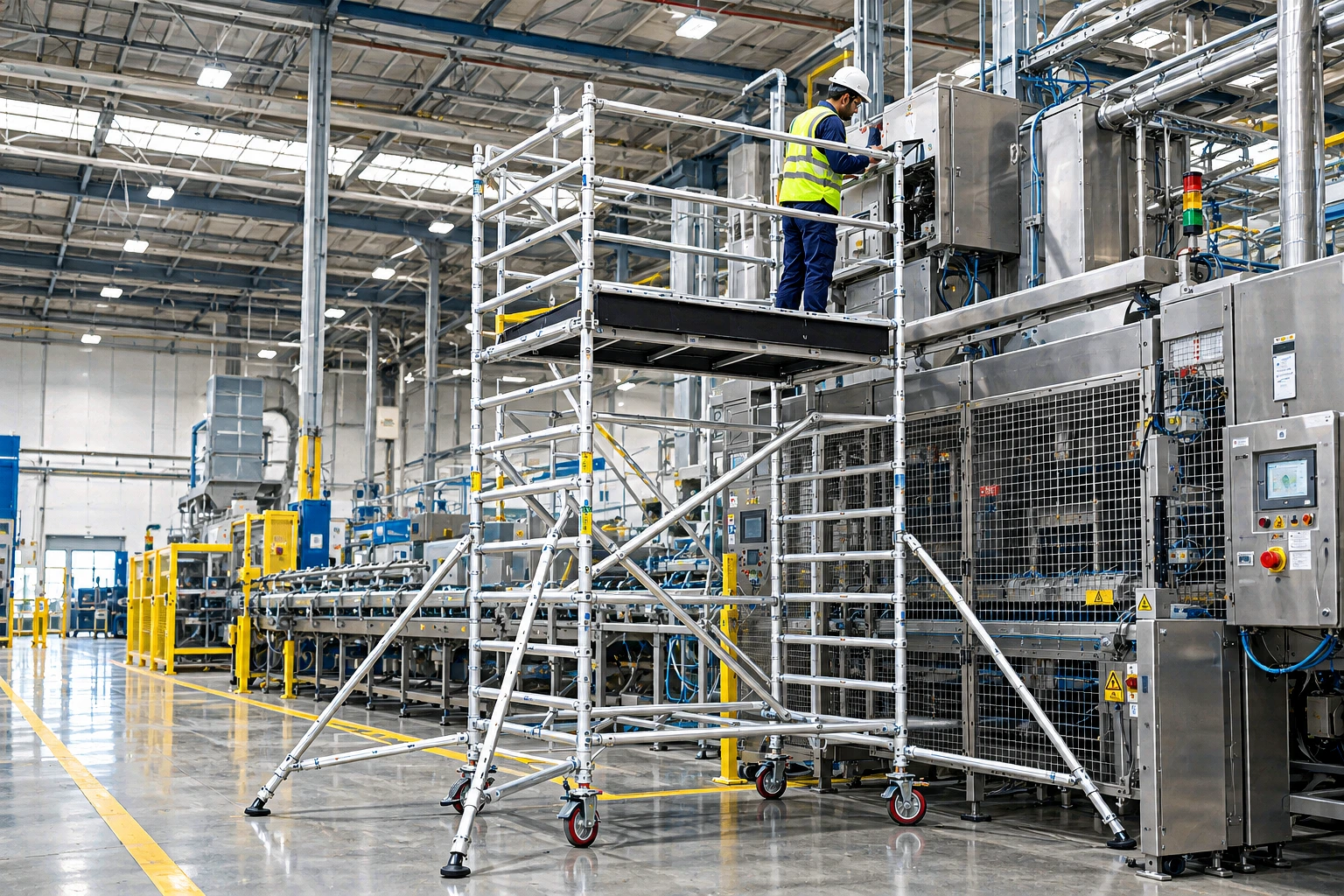
Recurring work such as equipment servicing, access to ducts and overhead services, and ceiling-level inspections is where lighter aluminium access earns its place, particularly where platforms need to move between jobs. For lighter inspection and servicing tasks, aluminium mobile scaffolding towers are one option. Those towers have anti-slip platforms, trap-door access, guard rails, stabilisers, and brake-equipped castors, and are suitable for indoor and outdoor use.
Planned Shutdowns and Turnarounds: A Hybrid Approach
Major turnarounds call for a realistic view. Aluminium suits lighter-duty platforms, stairs, decks, and access in restricted areas, while heavy structural access in large shutdowns is commonly steel. Combining steel and aluminium components works only within a single manufacturer's approved system, so a hybrid is specified as one system rather than assembled from mixed suppliers.
Oil and Gas, Manufacturing and Utility Facilities
In oil and gas facilities, typical tasks include inspection platforms and access for equipment servicing. In manufacturing plants, aluminium access supports equipment servicing and reaching overhead services such as ducts and cable trays. In utility facilities, it supports routine inspection rounds and light maintenance access. The right system in each case depends on load, heat, and exposure at that location.
Safety, Environmental and Selection Considerations in the UAE
Heat, Dust, Humidity and Coastal Exposure
Chloride-laden air near the coast can pit aluminium, and humidity adds to the risk wherever dissimilar metals touch. Dust can affect locking parts and moving components, so they need regular cleaning and checking. Cleaning chemicals outside the oxide layer's safe pH range can damage the surface, and high temperatures reduce aluminium's strength. For context, the UAE's midday outdoor-work ban runs from 15 June to 15 September, between 12:30 and 3:00 pm, which makes efficient erection windows more relevant. Aluminium does not solve heat or remove the ban.
Electrical, Hot-Work and Chemical Hazards
Aluminium conducts electricity, so work near live equipment must follow site electrical safety rules and may call for non-conductive alternatives. Hot work can damage components through heat and spatter, and process chemicals can attack the surface, so the work area should be assessed before aluminium access is erected. Where aluminium contacts steel structure or pipework, isolating the two may be needed to prevent galvanic corrosion.
Load, Height, Ground Conditions and Applicable Standards
Selection depends on load class, working height, ground conditions, wind exposure, manufacturer specifications, and competent erection, with inspection and tagging by a competent person. Two standard families apply: EN 1004-1 for mobile towers, and EN 12810 and EN 12811 for modular scaffolds. For local rules, Dubai Municipality's Code of Construction Safety Practice includes a scaffolding safety chapter, and Abu Dhabi operates under the ADOSH-SF framework. Current requirements should be confirmed in the official documents for the site. Ground conditions are easy to overlook on a plant floor: base plates need a suitable bearing surface, and drains, trenches, and service covers should be identified before the structure goes up.
Frequently Asked Questions
1. Why is modular aluminium scaffolding preferred for industrial facilities?
It is preferred in suitable applications because aluminium components are light to carry into restricted areas, resist corrosion in many environments, and go up and come down quickly as prefabricated parts. The preference has limits: heavy loads, high heat, and long-duration structures usually favour steel.
2. Is aluminium scaffolding strong enough for plant maintenance?
Yes, for light-to-medium loads within the manufacturer's rated limits. It is not a substitute for steel in heavy-duty work, because aluminium is less stiff and loses strength as temperature rises.
3. What makes aluminium scaffolding suitable for UAE industrial facilities?
Its low weight and corrosion behaviour suit many indoor and sheltered plant areas. The limits are heat and chlorides: strength falls at high temperature, and coastal or polluted air can cause pitting, so the manufacturer's limits and the site exposure decide suitability.
4. Can modular aluminium scaffolding be used during shutdowns and turnarounds?
Yes, for lighter access such as platforms, stairs, and decks, and as part of a hybrid setup alongside steel for heavy structural access. Any hybrid must stay within one manufacturer's approved system.
5. Where should aluminium scaffolding not be used in a plant?
Avoid it near high heat or hot work, near live electrical equipment unless site electrical precautions are in place, in aggressive chemical areas, and wherever heavy loads are required.
Choosing the Right Access System for Your Facility
Three questions narrow the choice quickly.
-
What load and working height are needed? Heavy or tall structures point toward steel.
-
What heat, electrical, and chemical exposure is present? High heat, live equipment, and aggressive chemicals call for caution with aluminium.
-
How often will the access need to move or be reconfigured? Frequent repositioning favours lighter components.
Aluminium suits light-to-medium, frequently repositioned access in restricted areas, while steel suits heavy, hot, or long-duration structures. Matching the material to those answers matters more than any general preference.


